I develop optimization-based methods that enable robots to plan and coordinate their motions safely and efficiently. My research connects distributed optimization, geometry-aware collision avoidance, and trajectory optimization, with particular attention to robot shape, computational efficiency, and coordination among heterogeneous robots.
I received my B.Sc. in Automation and M.Sc. in Control Science and Engineering from Tongji University in 2021 and 2024, respectively. During my master’s studies, I worked in the IVCM lab, supervised by Prof. Zhuping Wang and working closely with Prof. Hao Zhang.
I know that my work is not perfect, and I appreciate the time and care that reviewers put into improving it. Once a paper’s review process is complete, I would be glad to discuss its strengths and limitations with anyone who helped review it. As a small thank-you for your service, I would be happy to treat you to a drink or lunch. Meet me in person (e.g., at a conference) to redeem this offer!
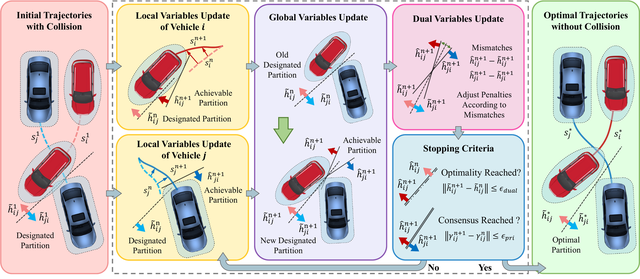
This paper presents a distributed cooperative-planning framework for heterogeneous robots operating in shared and space-constrained environments. We propose novel geometry-aware collision-free constraints that support low-conservatism representations of heterogeneous robot shapes. These constraints are analytical and separable, making them naturally suited for distributed optimization. Leveraging this separable nature, we develop a distributed planning framework based on the alternating direction method of multipliers that decomposes the computational burden across robots. The framework directly handles nonlinear and non-convex coupling constraints without linearization, and any converged solution satisfies the Karush-Kuhn-Tucker conditions of the original global cooperative-planning problem. To improve per-robot computational efficiency, acceleration techniques including dimension reduction and block coordinate descent are incorporated. Moreover, clear geometric interpretations of the coordination mechanism are provided to enhance algorithmic interpretability in practical deployment. Comprehensive validation through simulations, hardware experiments, and benchmark comparisons demonstrates the framework’s effectiveness in enabling safe, high-quality, and efficient coordination for heterogeneous robots.
@article{wu_cooperative_2026,title={Cooperative {Geometry}-{Aware} {Collision} {Avoidance} for {Heterogeneous} {Robots} {Via} {Negotiation} on {Separating} {Hyperplanes}},url={https://ieeexplore.ieee.org/document/11731809/},doi={10.1109/TRO.2026.3742236},journal={IEEE Transactions on Robotics},author={Wu, Zeming and Fu, Chengcheng and Hao, Yahui and Liu, Lu},year={2026},pages={1--20}}
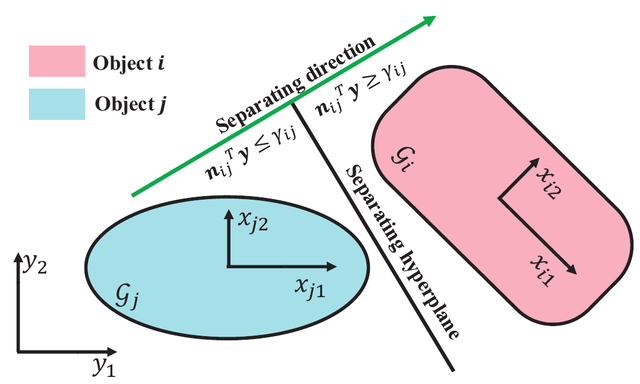
This paper presents a novel collision avoidance method for general ellipsoids based on control barrier functions (CBFs) and separating hyperplanes. First, collision-free conditions for general ellipsoids are analytically derived using the concept of dual cones. These conditions are incorporated into the CBF framework by extending the system dynamics of controlled objects with separating hyperplanes, enabling efficient and reliable collision avoidance. The validity of the proposed collision-free CBFs is rigorously proven, ensuring their effectiveness in enforcing safety constraints. The proposed method requires only single-level optimization, significantly reducing computational time compared to state-of-the-art methods. Numerical simulations and real-world experiments demonstrate the effectiveness and practicality of the proposed algorithm.
@inproceedings{wu_collision-free_2025,address={Hangzhou, China},title={Collision-free {Control} {Barrier} {Functions} for {General} {Ellipsoids} via {Separating} {Hyperplane}},url={https://ieeexplore.ieee.org/document/11247279/},doi={10.1109/IROS60139.2025.11247279},booktitle={2025 {IEEE}/{RSJ} {International} {Conference} on {Intelligent} {Robots} and {Systems} ({IROS})},publisher={IEEE},author={Wu, Zeming and Liu, Lu},month=oct,year={2025},pages={19637--19644}}
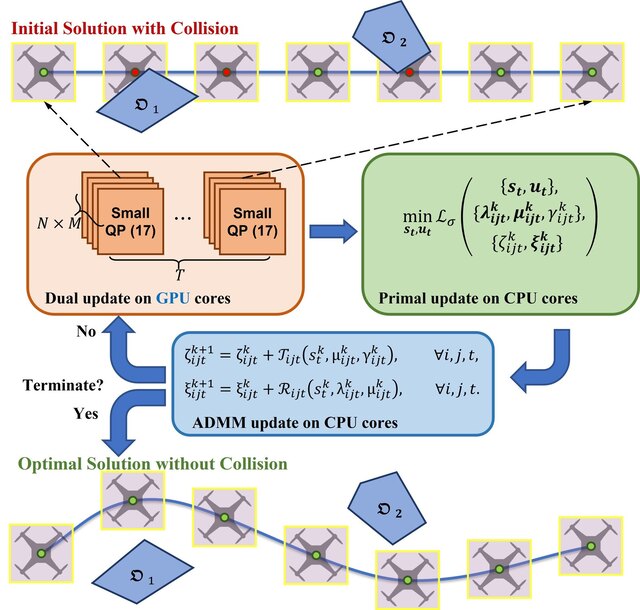
This paper proposes a GPU-accelerated optimization framework for collision avoidance problems where the controlled objects and the obstacles can be modeled as the finite union of convex polyhedra. A novel collision avoidance constraint is proposed based on scale-based collision detection and the strong duality of convex optimization. Under this constraint, the high-dimensional non-convex optimization problems of collision avoidance can be decomposed into several low-dimensional quadratic programmings (QPs) following the paradigm of alternating direction method of multipliers (ADMM). Furthermore, these low-dimensional QPs can be solved parallel with GPUs, significantly reducing computational time. High-fidelity simulations are conducted to validate the proposed method’s effectiveness and practicality.
@inproceedings{wu_gpu-accelerated_2024,address={Yokohama, Japan},title={{GPU}-{Accelerated} {Optimization}-{Based} {Collision} {Avoidance}},url={https://ieeexplore.ieee.org/document/10610871/},doi={10.1109/ICRA57147.2024.10610871},booktitle={2024 {IEEE} {International} {Conference} on {Robotics} and {Automation} ({ICRA})},publisher={IEEE},author={Wu, Zeming and Wang, Zhuping and Zhang, Hao},month=may,year={2024},pages={7561--7567}}
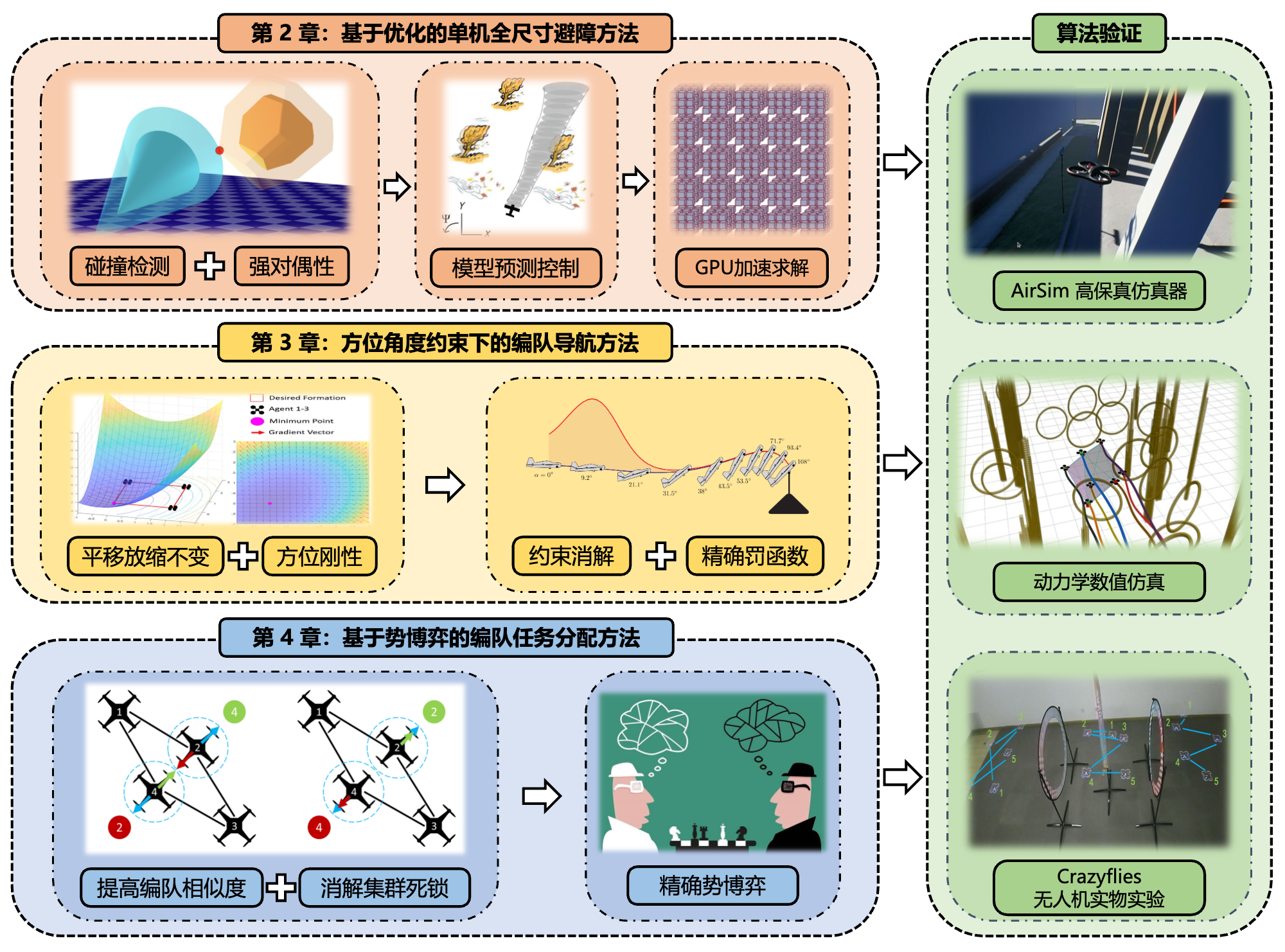
This thesis develops optimization-based methods for multi-robot formation navigation in cluttered environments. It combines geometry-aware collision avoidance for individual robots, bearing-constrained trajectory optimization for coordinated formations, and distributed task assignment based on exact potential games to resolve deadlocks. Simulations and hardware experiments evaluate the resulting planning and coordination methods.