Research
Distributed optimization, geometry-aware collision avoidance, and motion planning.
Research overview
I develop optimization-based methods for safe and efficient robot motion, connecting distributed optimization, geometry-aware collision avoidance, and trajectory generation for multi-agent systems.
Cooperative Geometry-Aware Collision Avoidance for Heterogeneous Robots Via Negotiation on Separating Hyperplanes
IEEE Transactions on Robotics (T-RO), 2026
I develop a distributed cooperative-planning framework for heterogeneous robots using geometry-aware collision constraints. Separating hyperplanes provide a negotiation mechanism between robots, while ADMM, dimension reduction, and block coordinate descent distribute and accelerate the computation. The method is evaluated through numerical simulations, hardware experiments, and benchmark comparisons.
Quaternion-Based Optimal Interpolation of Similarity Transformations for Multi-Agent Formation
IEEE Robotics and Automation Letters (RA-L), 2024
I use quaternion-based representations to generate coordinated formation motions through optimal interpolation of similarity transformations. The formulation addresses distance, energy, and smoothness objectives, with polynomial approximation used to reduce computation while preserving the structure of the optimal trajectory.
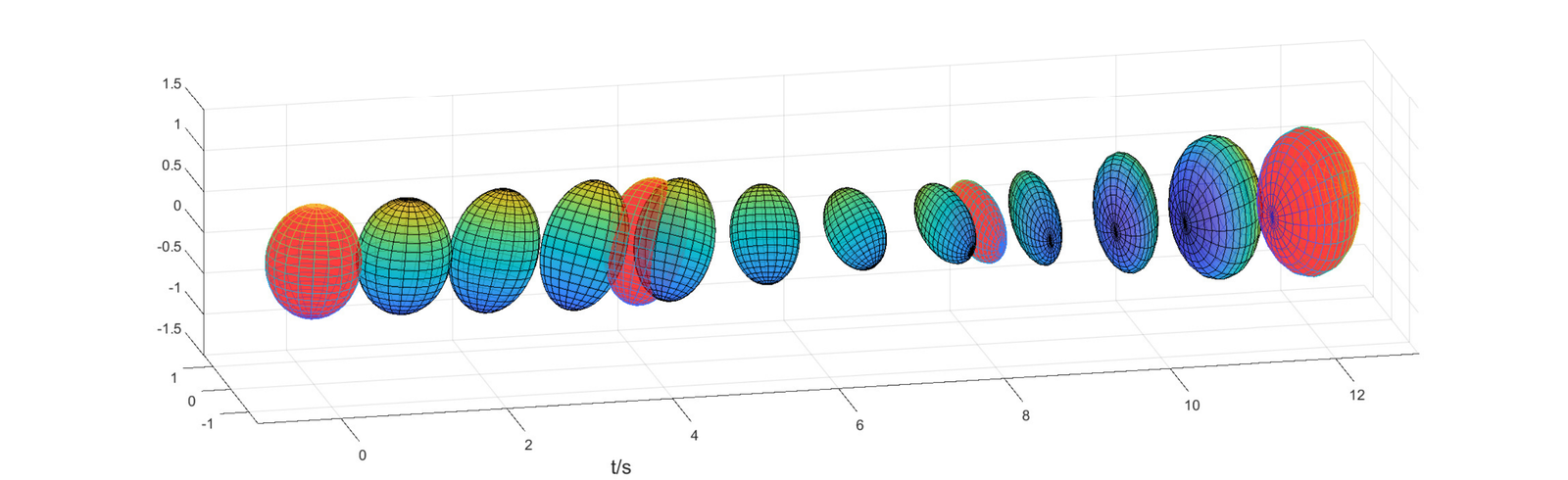
Collision-free Control Barrier Functions for General Ellipsoids via Separating Hyperplane
IEEE/RSJ International Conference on Intelligent Robots and Systems (IROS), 2025
I construct geometry-aware control barrier functions for general ellipsoids using separating hyperplanes and dual cones. The analytical formulation avoids an additional optimization layer for evaluating the barrier functions, leaving a single-level control optimization. Numerical simulations and Robotarium hardware experiments demonstrate the approach.
GPU-Accelerated Optimization-Based Collision Avoidance
IEEE International Conference on Robotics and Automation (ICRA), 2024
I formulate geometry-aware collision-avoidance constraints for objects represented by unions of convex polyhedra. An ADMM-based decomposition separates the optimization into smaller quadratic programs that can be solved in parallel on GPUs. High-fidelity quadrotor simulations evaluate the method’s computational efficiency and collision-avoidance performance.
Local-Bearing-Based Prescribed-Time Distributed Localization of Multiagent Systems With Noisy Measurement
IEEE Transactions on Industrial Informatics (TII), 2024
This work studies distributed localization of multi-agent systems using local bearing measurements, with prescribed-time convergence in the presence of measurement noise.
Decentralized Pursuit of an Evader With Probabilistic Collision-Free for Differential Drive Robots
IEEE Transactions on Cybernetics (TCYB), 2026
This collaborative work addresses decentralized pursuit under perception uncertainty. Chance-constrained pursuit Voronoi cells and a distributed control policy support probabilistic collision avoidance for differential-drive robots, with validation through simulations and experiments.
Thesis
Formation Navigation in Cluttered Environments
This thesis develops optimization-based methods for multi-robot formation navigation in cluttered environments. It combines geometry-aware collision avoidance for individual robots, bearing-constrained trajectory optimization for coordinated formations, and distributed task assignment based on exact potential games to resolve deadlocks. Simulations and hardware experiments evaluate the resulting planning and coordination methods.
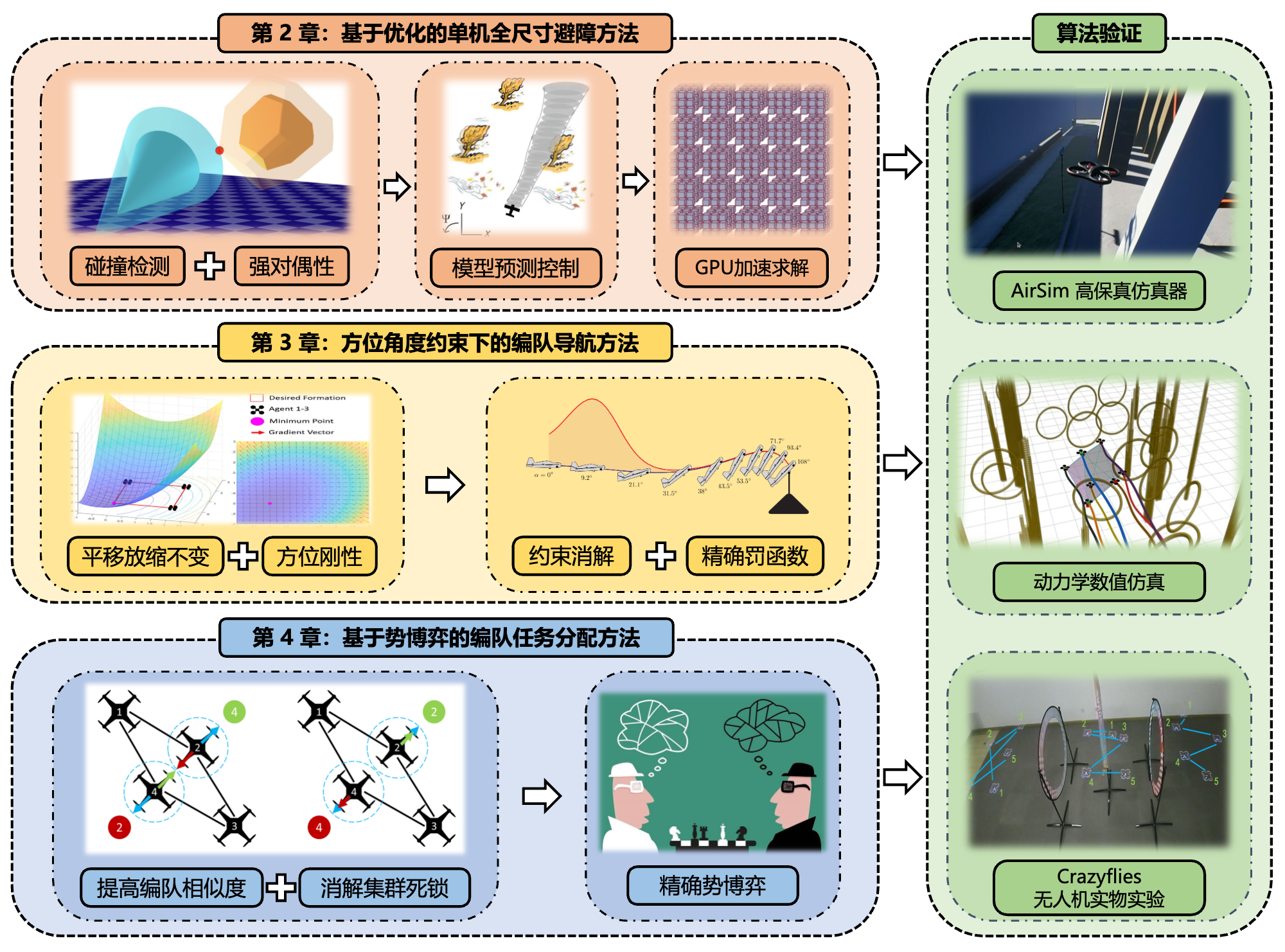
Download thesis in Chinese (PDF) · 31 MB
For full citations and author lists, see my publications. I welcome research discussions about optimization-based planning and coordination: zeming.wu@my.cityu.edu.hk.